Data shown in the Educational Opportunity Trends Explorer are from SEDA 2025.1. A simplified description of methodology to construct these estimates is provided here. For more detail on how we construct the estimated test score parameters, please see the SEDA 2025 Technical Documentation (downloadable on the Get the Data page). For more detail on the statistical methods that we use, as well as information about the accuracy of the estimates, please see our technical papers. Not all data from SEDA 2025 is visualized on the Educational Opportunity Trends Explorer; the complete data are downloadable on the Get the Data page.
What is SEDA 2025?
SEDA 2025 is a release of the Stanford Education Data Archive designed to provide insight into trends in school and district average achievement and learning rates from 2009-2025.
In our explorer, we highlight the recent trends by showcasing the average achievement, trend in achievement, learning rate, and trend in learning rate from 2022-2025.
Source Data
Federal law requires all states to test all students in grades 3-8 each year in math and RLA (commonly called “accountability” testing). It also requires that states make the aggregated results of those tests public. We use this state reported proficiency data from two sources:
- The 2009-2019 state proficiency data come from the EDFacts Database, collected by the National Center for Education Statistics (NCES). There are two versions of these data: a public version, available on their website, and a restricted version, available by request. In the public files, data for small places or small subgroups are not reported to ensure the privacy of the students. In contrast, the restricted files contain all data, regardless of the number of students within the school/district or subgroup. We use the restricted files and aggregate the school-level data to other relevant units (e.g., administrative school districts and states). Due to changes in the data collection used by EDFacts, we changed to different source data after 2019.
- The 2022-2025 state proficiency data come from the Education Data Center’s State Assessment Data Repository (SADR). SADR includes publicly-available assessment data from all 50 states and D.C. for students in grades 3-8, reported at the state-, administrative school district-, and school- levels, and disaggregated by subject, grade level and student subgroups. Because these are public data, data for small places or small subgroups are often suppressed to maintain student privacy. There are also variations in the data that states report (e.g., some states may not report tested counts of students or data for subgroups). We have taken measures to clean these data, so that we retain the maximum number of states, districts, and schools in our sample.
From the available data, we use:
- All 50 states and DC
- School years 2008-09 through 2022-25
- Grades 3-8
- Math and RLA
- Various subgroups of students: all students, racial/ethnic subgroups, gender subgroups, and economic subgroups
We also draw on the National Assessment of Educational Progress (NAEP) 2009-2024 administrations in 4th and 8th grade to link the district estimates to a scale that is comparable among states and over grades and years.
Definition of a School District
We report estimates for administrative school districts. Administrative school districts operate sets of public schools, including charters. The schools operated by each school district are identified using the National Center for Education Statistics (NCES) school and district identifiers. Most commonly, administrative school districts operate local public schools within a given physical boundary; these are what we refer to as “traditional public school districts.” There are specialized administrative districts, like charter school and virtual school districts, that do not have a physical boundary. These districts will not appear on our maps; their data, however, are available in the download files.
Administrative districts differ from the geographic districts used in SEDA 6.0 and visualized on the Educational Opportunity Explorer. The key difference is that for geographic school districts, we “reassign” charter schools to the district in which they are physically located (regardless of the entity that operates the schools). We do no reassignment of charter schools in producing the administrative district estimates; charter schools are attached to the traditional public or charter district that operates them.
We use administrative districts in SEDA 2025 for two reasons. First, one of our aims is to help school districts understand their learning needs. Administrative districts have authority to set policy for their schools, as such it is most useful for the estimates to reflect only the schools under their operation. Second, to construct geographic school districts, we need data for individual schools. While many states report school-level data publicly, the data for many schools is suppressed due to the small numbers of students taking assessments. Because of this we cannot reliably construct geographic school district estimates from the 2022-2025 EDC source data.
Challenges Working with Proficiency Data
While there is a substantial amount of data from every state available in EDFacts, there are four key challenges when using these data:
-
States provide only “proficiency data”: the count of students at each of the proficiency levels (sometimes called “achievement levels” or “performance levels”). The levels represent different degrees of mastery of the subject-specific grade-level material. Levels are defined by score “thresholds” (sometimes called “cut scores”), which are set by experts in the field. Scoring above or below different thresholds determines placement in a specific proficiency level. Common levels include “below basic,” “basic,” “proficient,” and “advanced.” An example is shown below.
Test Score Proficiency Level Description 200-500 Below Basic Inadequate performance; minimal mastery 501-600 Basic Marginal performance; partial mastery 601-700 Proficient Satisfactory performance; adequate mastery 701-800 Advanced Superior performance; complete mastery -
Most states use their own test and define “proficiency” in different ways, meaning that we cannot directly compare test results in one state to those in another. Proficient in one state/grade/year/subject is not comparable to proficient in another.
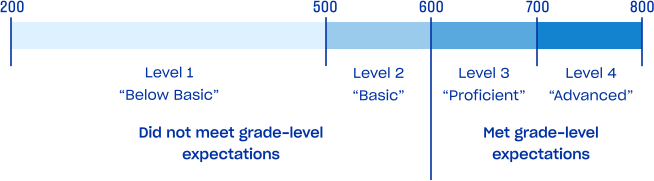
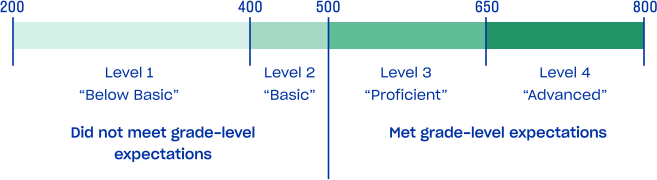
Consider two states that use the same test, which is scored on a scale from 200 to 800 points. Each state sets its own threshold for proficiency at different scores.
State A: Higher threshold for proficiency
State B: Lower threshold for proficiency
Imagine 500 students take the test. The results are as follows:
Score Number of Students State A Proficiency Category State B Proficiency Category Below 400 50 Level 1 Level 1 400-500 100 Level 1 Level 2 500-600 200 Level 2 Level 3 600-650 50 Level 3 Level 3 605-700 50 Level 3 Level 4 Above 700 50 Level 4 Level 4 If we use State A’s thresholds for assignment to categories, we find that 150 students are proficient. However, if we use State B’s thresholds, 350 students are proficient.
Not Proficient Proficient State Level 1 Level 2 Level 3 Level 4 A 150 200 100 50 B 50 100 250 100 In practice, this means that students in State B may appear to have higher “proficiency” rates than those in State A—even if their true achievement patterns are identical! Using the proficiency data without accounting for differing proficiency thresholds may lead to erroneous conclusions about the relative performance of students in different states.
This problem is more complicated than the example suggests, because most states use different tests with material of varying difficulty and scores reported on different scales. Therefore, we cannot compare proficiency, nor can we compare students’ test scores between states. -
Even within a state, different tests are used in different grade levels. This means that we cannot readily compare the performance of students in 4th grade in one year to that of students in 5th grade in the next year. Therefore, we cannot measure average learning rates across grades.
-
States may change the tests they use over time. This may result from changes in curricular standards; for example, the introduction of the Common Core State Standards led many states to adopt different tests. These changes make it hard to compare average performance in one year to that of the next. Therefore, we cannot readily measure trends in average performance over time.
SEDA methods: Addressing the challenges
While these challenges are substantial, they are not insurmountable. The EOP team has developed methods to address these challenges in order to produce estimates of students’ average test scores, average learning rates across grades, trends in test scores, and trends in learning rates in each unit (e.g., school, geographic district, etc.). All estimates are comparable across states, grades, and years.
Below we describe the raw data used to create SEDA and how we:
- Estimate the location of each state’s proficiency thresholds
- Estimate mean test scores from the raw data and the threshold estimates
- Place mean test scores on the same scale
- Scale the estimates so they are measured in terms of grade levels
- Estimate average scores, trends in average scores, learning rates, and trends in learning rates
Estimating the location of each state’s proficiency thresholds
For 2009-2019, we use a statistical technique called heteroskedastic ordered probit (HETOP) modeling to estimate the location of the thresholds that define the proficiency categories within each state, subject, grade, and year. We estimate the model using all the counts of students in each school district within a state-subject-grade-year.
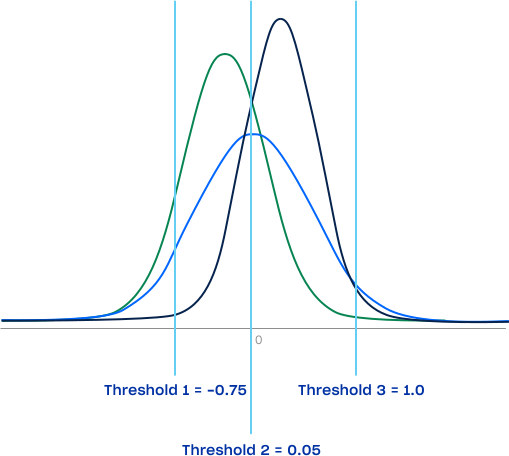
A simplified description of this method follows. We assume the distribution of test scores in each school district is bell-shaped. For each state, grade, year, and subject, we then find the set of test-score thresholds that meet two conditions: 1) they would most closely produce the reported proportions of students in each proficiency category; and 2) they represent a test-score scale in which the average student in the state-grade-year-subject has a score of 0 and the standard deviation of scores is 1.
Example: State A, Grade 4 reading in 2014–15
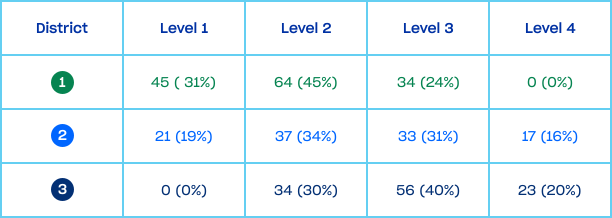
In the example below, there are three districts in State A. The table shows the number and proportion of scores in each of the state’s four proficiency categories. District 1 has more lower-scoring students than the others; District 3 has more higher-scoring students. Assuming each district’s test-score distribution is bell-shaped, we determine where the three thresholds would be located that would yield the proportions of students in each district shown in the table. In this example, the top threshold is one standard deviation above the statewide average score. At this value, we would expect 0% of students from District 1, 16% of students from District 2, 20% of students from District 3 to score in the top proficiency category.
For 2022-2025, we assume the state-subject-grade-year test score distribution is normal and use the inverse cumulative standard normal distribution function to find the threshold associated with the proportions of students scoring in each category in the state, subject, grade, and year.
Estimating the mean from proficiency count data
The next step of our process is to estimate the mean test score in each unit for all students and by student subgroup (gender, race/ethnicity, and economic disadvantage). To do this, we estimate heteroskedastic ordered probit models using both the raw proficiency count data (shown above) and the thresholds from the prior step. This method allows us to estimate the mean standardized test score in each unit for every subgroup, subject, grade, and year on a scale that is standardized within state, subject, grade, and year.
For more information, see Reardon, Shear, et al. (2017); and Shear and Reardon (2020).
Placing mean test scores on the same scale
We cannot compare the estimated means across states, grades, and years because states use different tests with completely different scales and set their proficiency thresholds at different levels of mastery. Knowing that a mean is one standard deviation above the state average score does not help us compare means across places, grades, or years because we do not know how a state’s average score in one grade and year compares to that in other states, grades, and years.
Luckily, we can use the National Assessment of Educational Progress (NAEP), a test taken in every state, to place the thresholds on the same scale. This step facilitates comparisons across states, grades, and years.
A random sample of students in every state takes the NAEP assessment in Grades 4 and 8 in math and RLA every other year (e.g., 2009, 2011, 2013, 2015, 2017, 2019, 2022, and 2024). From NAEP, then, we know the relative performance of states on the NAEP assessment. In the grades and years when NAEP assessments were not administered to students (except 2025), we average the scores in the grades and years just before and just after to obtain estimates for untested grades, subjects, and years. In 2025, we do not have both 2024 and 2026 NAEP scores that we can average as the 2026 NAEP has not been released to date. Instead, we estimate states’ 2025 NAEP scores using historical information about the relationship between state and NAEP test score trends in years states tests do not change. For more information on this approach, see: SEDA 2025.1 Technical Documentation, Appendix A 2.
We use the states’ NAEP results in each grade, year, and subject to rescale the means to the NAEP scale. For each subject, grade, and year, we multiply the mean by the state’s NAEP standard deviation and add the state’s NAEP average score.
Example: State A, Grade 4 reading in 2014–15
The average score and standard deviation of State A NAEP scores in Grade 4 reading in 2014–15 were:
- Mean NAEP Score: 200
- Standard Deviation of NAEP Score: 40
We have the mean test score estimate for a District 1 of -0.75.
We can convert District 1’s mean test score onto the NAEP scale. First, we multiply by 40. Then, we add 200:
(-0.75 x 40.0) + 200 = 170
This yields a new “linked” mean test score 1 of 170.
We repeat this step for every state in every subject, grade, and year. The result is a set of thresholds for every state, subject, grade, and year that are all on the same scale, the NAEP scale.
For more information, see Reardon, Kalogrides & Ho (2019).
Scaling the estimates to grade equivalents
On the website, we report all data in grade levels, or what we call the Grade (within Cohort) Standardized (GCS) scale. On this scale, users can interpret one unit as one grade level. The national average performance is 3 in Grade 3, 4 in Grade 4, and so on.
To convert our estimates from the NAEP scale into grade levels, we first approximate the average amount student test scores grow in a grade on NAEP. To do this, we use NAEP data for 4th and 8th graders in 2019. We calculate the amount the test scores differed between 4th and 8th grade (Average 4th to 8th Grade Growth) as the average score in 8th grade minus the average score in 4th grade. Then, to get an estimate of per-grade growth, we divide that value by 4 (Average Per-Grade Growth).
| 4th Grade Score | 8th Grade Score | 4th to 8th Grade Growth | Per-Grade Growth | |
|---|---|---|---|---|
| Math | 279.9 | 281.0 | 41 | 10.25 |
| Reading | 218.1 | 260.6 | 42.5 | 10.625 |
Now, we can use these numbers to rescale the SEDA estimates that are on the NAEP scale into grade equivalents. From the SEDA estimates we subtract the 4th-grade average score, divide by the per-grade growth, and add 4.
Example: Converting NAEP scores into grade levels
A score of 250 in 4th-grade math becomes:
(250 – 238.9)/10.25 + 4 = 5.08.
In other words, these students score at a 5th-grade level, or approximately one grade level ahead of the national average (the reference group) in math.
A score of 200 in 3rd-grade reading becomes:
(200 – 218.1)/10.625 + 4 = 2.30.
In other words, these students score a little more than half a grade level behind the national average for 3rd graders in reading.
The four parameters reported in our explorer
After estimating the mean test scores using the process above, we summarize the test score data for each place using hierarchical linear models. These models produce estimates of the average test scores, learning rates, and trends in each that are reported in our explorer. The intuition behind how these estimates are constructed is described in this section.
We produce these four parameters separately for 2009-2019 and 2022-2025 because of the educational disruptions occurring as part of the COVID-19 pandemic and because of the two-year break in the source data. In our explorer, we report the parameters for 2022-2025. In our downloadable files, both sets of parameters are available.
Average test scores and trends in test scores
We have measures of the average test scores in up to 66 grade-year cells in each tested subject for each unit reported on the GCS scale described above. The scores are adjusted so that a value of 3 corresponds to the average achievement of 3rd graders nationally, a value of 4 corresponds to the average achievement of 4th graders nationally, and so on. For each subject, these can be represented in a table like this:
| Year | ||||
|---|---|---|---|---|
| Grade | 2022 | 2023 | 2024 | 2025 |
| 8 | 8.10 | 8.19 | 8.28 | 8.37 |
| 7 | 7.18 | 7.25 | 7.32 | 7.39 |
| 6 | 6.26 | 6.31 | 6.36 | 6.41 |
| 5 | 5.34 | 5.37 | 5.40 | 5.43 |
| 4 | 4.42 | 4.43 | 4.44 | 4.45 |
| 3 | 3.50 | 3.49 | 3.48 | 3.47 |
We can take the average of these scores by year (averaged across grades), shown in the “Average” row in the table below. In this example, the average score in 2022 is 5.8.
| Year | ||||
|---|---|---|---|---|
| Grade | 2022 | 2023 | 2024 | 2025 |
| 8 | 8.10 | 8.19 | 8.28 | 8.37 |
| 7 | 7.18 | 7.25 | 7.32 | 7.39 |
| 6 | 6.26 | 6.31 | 6.36 | 6.41 |
| 5 | 5.34 | 5.37 | 5.40 | 5.43 |
| 4 | 4.42 | 4.43 | 4.44 | 4.45 |
| 3 | 3.50 | 3.49 | 3.48 | 3.47 |
| Average | 5.80 | 5.84 | 5.88 | 5.92 |
To get an overall average, we then average those annual scores across years, shown in the far-right column. In this example, the average score, across grades and years is 5.86. In the explorer, we report the average test scores relative to the national average. The national average is 5.5, so we would report this average test score as “0.36 grade levels above the national average.”
| Year | Average | ||||
|---|---|---|---|---|---|
| Grade | 2022 | 2023 | 2024 | 2025 | |
| 8 | 8.10 | 8.19 | 8.28 | 8.37 | |
| 7 | 7.18 | 7.25 | 7.32 | 7.39 | |
| 6 | 6.26 | 6.31 | 6.36 | 6.41 | |
| 5 | 5.34 | 5.37 | 5.40 | 5.43 | |
| 4 | 4.42 | 4.43 | 4.44 | 4.45 | |
| 3 | 3.50 | 3.49 | 3.48 | 3.47 | |
| Average | 5.80 | 5.84 | 5.88 | 5.92 | 5.86 |
To get the trend in average test scores, we first look at the change in average scores from the prior year (shown in the Change row at the bottom of the table). The average score increased by 0.04 grade levels each year, from 5.8 in 2022 to 5.92 in 2025. We then average the changes over years in the far-right column to get the overall trend, which is 0.04. In the explorer, we would report the trend in test scores as increasing “0.04 grade levels/year.”
| Year | Average | ||||
|---|---|---|---|---|---|
| Grade | 2022 | 2023 | 2024 | 2025 | |
| 8 | 8.10 | 8.19 | 8.28 | 8.37 | |
| 7 | 7.18 | 7.25 | 7.32 | 7.39 | |
| 6 | 6.26 | 6.31 | 6.36 | 6.41 | |
| 5 | 5.34 | 5.37 | 5.40 | 5.43 | |
| 4 | 4.42 | 4.43 | 4.44 | 4.45 | |
| 3 | 3.50 | 3.49 | 3.48 | 3.47 | |
| Average | 5.80 | 5.84 | 5.88 | 5.92 | 5.86 |
| Change | 0.04 | 0.04 | 0.04 | 0.04 | |
Average learning rates and trends in learning rates
We measure learning rates by observing how average scores change for students in the same cohort as they move up in grade levels. To do this, we again start from the table of up to 24 average test scores:
| Year | ||||
|---|---|---|---|---|
| Grade | 2022 | 2023 | 2024 | 2025 |
| 8 | 8.10 | 8.19 | 8.28 | 8.37 |
| 7 | 7.18 | 7.25 | 7.32 | 7.39 |
| 6 | 6.26 | 6.31 | 6.36 | 6.41 |
| 5 | 5.34 | 5.37 | 5.40 | 5.43 |
| 4 | 4.42 | 4.43 | 4.44 | 4.45 |
| 3 | 3.50 | 3.49 | 3.48 | 3.47 |
We then can calculate changes in scores from one grade and year to the next grade and year. We can show these changes in a new table, below. Here, each cell represents the change in average scores from one grade and year to the next grade and year. For example, average scores rose from 7.18 in grade 7 in 2022 to 8.19 in grade 8 in 2025. This change of 1.01 grade levels is shown in the upper left cell corresponding to grades 7-8 and years 2022-2023.
| Years | |||
|---|---|---|---|
| Grades | 2022-2023 | 2023-2024 | 2024-2025 |
| 7-8 | 1.01 | 1.03 | 1.05 |
| 6-7 | 0.99 | 1.01 | 1.03 |
| 5-6 | 0.97 | 0.99 | 1.01 |
| 4-5 | 0.95 | 0.97 | 0.99 |
| 3-4 | 0.93 | 0.95 | 0.97 |
We can take the average of these 1-year learning rates within each column (averaging across grades), shown in the “Average” row at the bottom of the table. In this example, from 2022-2023, students learned an average of .97 grade levels.
| Years | |||
|---|---|---|---|
| Grades | 2022-2023 | 2023-2024 | 2024-2025 |
| 7-8 | 1.01 | 1.03 | 1.05 |
| 6-7 | 0.99 | 1.01 | 1.03 |
| 5-6 | 0.97 | 0.99 | 1.01 |
| 4-5 | 0.95 | 0.97 | 0.99 |
| 3-4 | 0.93 | 0.95 | 0.97 |
| Average | 0.97 | 0.99 | 1.01 |
Then we can average those scores across years, shown in the far-right column. The average learning rate across grades and years is 0.99. In the explorer, we show learning rates relative to the national average. The national average learning rate is 1 grade level per year, so we would report that the learning rate is “close to the national average.”
| Years | Average | |||
|---|---|---|---|---|
| Grades | 2022-2023 | 2023-2024 | 2024-2025 | |
| 7-8 | 1.01 | 1.03 | 1.05 | |
| 6-7 | 0.99 | 1.01 | 1.03 | |
| 5-6 | 0.97 | 0.99 | 1.01 | |
| 4-5 | 0.95 | 0.97 | 0.99 | |
| 3-4 | 0.93 | 0.95 | 0.97 | |
| Average | 0.97 | 0.99 | 1.01 | 0.99 |
To get the trend in learning rates, we first look at the change in the average learning rate from one year to the next. The learning rate increased by 0.02 grade levels each year, from .97 in 2022-2023 to 1.01 in 2024-2025. Then, to get the overall trend, we average those values across years (shown in the far-right column) to get 0.02. In the explorer, we would report the trend in learning rates as increasing “0.02 grade levels/year.”
| Years | Average | |||
|---|---|---|---|---|
| Grades | 2022-2023 | 2023-2024 | 2024-2025 | |
| 7-8 | 1.01 | 1.03 | 1.05 | |
| 6-7 | 0.99 | 1.01 | 1.03 | |
| 5-6 | 0.97 | 0.99 | 1.01 | |
| 4-5 | 0.95 | 0.97 | 0.99 | |
| 3-4 | 0.93 | 0.95 | 0.97 | |
| Average | 0.97 | 0.99 | 1.01 | 0.99 |
| Change | 0.02 | 0.02 | 0.02 | |
The above illustrates intuitively how we estimate the four parameters and how to interpret them. In practice, we use hierarchical linear models to produce these estimates. These models help overcome data challenges, for example, missing estimates in some grades or years and variable precision of the estimates among grades and years. For more details on the models, please review the technical documentation.
Data reporting
Estimates Shown on the Website
We report 2022-2025 average test scores, trends in average test scores, learning rates, and trends in learning rates for schools, administrative districts, and states in our Educational Opportunity Trends Explorer. To access data files with other types of estimates (e.g., estimates separately by subject, grade, and year), please visit our Get the Data page.
Similar Districts and Schools
On the website, we identify a set of five comparison places for each school and district. The “similar places” are chosen based on the following characteristics, averaged over 2022-2025, as reported in SEDA:
- the log of the average grade-level enrollment in grades 3 to 8
- the average proportion of students receiving federal subsidized lunches
- the average proportions of students who identify as Asian, Black, Hispanic, and White in the district
- the average proportions of students in urban schools, in suburban schools, and in town schools
- the average socioeconomic status (SES) of families in the district, where SES is measured using a composite index based on median family income, proportion of adults with a bachelor’s degree or higher, proportion of adults that are unemployed, the household poverty rate, the proportion of households receiving SNAP benefits, and the proportion of households with children that are headed by a single mother (note: this characteristic is not available for schools)
The set of similar places are those in the same state as the focal place that are most similar (closest in Mahalanobis distance) to it on these 5 dimensions.
Suppression of Estimates
We do not report estimates in the explorer if:
- Fewer than 20 students are represented in the estimate
- The estimates are too imprecise to be informative
Margins of Error
In some cases, estimates are imprecise; in some cases, an estimated change in average scores is not statistically distinguishable from zero. We have constructed margins of error for each of the estimates to help users identify such cases. We also do not show any estimates on the website where the margin of error is large. For those downloading the data and using it in analysis, standard errors are included in the downloadable data files.
Data accuracy
We have taken steps to ensure the accuracy of the data reported here. The statistical and psychometric methods underlying the data we report are summarized here and published in peer-reviewed journals.
First, we conduct statistical analyses to ensure that our methods of converting the raw data into measures of average test scores are accurate. For example, in a small subset of school districts, students take the NAEP test in addition to their state-specific tests. Since the NAEP test is the same across districts, we can use these districts’ NAEP scores to determine the accuracy of our method of converting the state test scores to a common scale. When we do this, we find that our measures are accurate, and generally yield the same conclusions about relative average test scores as we would get if all students took the NAEP test. For more information on these analyses, see Reardon, Kalogrides & Ho (2019).
Second, one might be concerned that our learning-rate estimates do not account for students moving in and out of schools and districts. For example, if many high-achieving students move out of a school or district in the later grades and/or many low-achieving students move in, the average test scores will appear to grow less from 3rd to 8th grade than they should. This would cause us to underestimate the learning rate in a school or district.
To determine the accuracy of our learning-rate estimates, we compared them to the estimated learning rate we would get if we could track individual students’ learning rates over time. Working with research partners who had access to student-level data in three states, we determined that our learning-rate estimates are generally sufficiently accurate to allow comparisons among districts and schools. We did find that our learning-rate estimates tend to be slightly less accurate for charter schools. On average, our estimated learning rates for charter schools tend to overstate the true learning rates in charter schools in these three states by roughly 5%. This is likely because charter schools have more student in- and out-mobility than traditional public schools. It suggests that learning-rate comparisons between charter and traditional public schools should be interpreted with some caution. For more information on these analyses, see Reardon et al. (2019).